When your family’s future is on the line, get clear advice on divorce, custody, maintenance and asset division directly from the lawyer handling your case.
4.8 ★★★★★ Google Rating
870+ Google Reviews
20+ Years Experience
Jonathan Wong, Principal Lawyer, personally handles your case from first call to final orders. Clear strategy, straight answers.
Tell us what happened. We will review and reply via WhatsApp with next steps.
Submitting the form takes less than 30 seconds.
No obligation. Strictly confidential.
Going through a divorce in Singapore means making decisions about your children, your home, your CPF and your finances, often all at once. As a divorce lawyer in Singapore with more than 20 years of experience before the Family Justice Courts, Jonathan Wong advises on uncontested and contested divorces, custody, care and control, maintenance, division of matrimonial assets and Personal Protection Orders. You get clear advice on your options, a fixed fee agreed upfront, and a lawyer who handles your case personally.
Whether your divorce is contested or uncontested, we guide you through every stage, from filing to Final Judgment, with a clear timeline and no surprises.
Learn About Divorce
Custody, care and control, and access arrangements, explained clearly, with your children's wellbeing at the centre of every decision.
Learn About Custody
How matrimonial assets are divided, and how maintenance for a spouse or children is calculated under Singapore law.
Learn About Assets
Verified feedback from clients we have represented, published on our Google Business Profile.
Transparent fixed fees, agreed in writing upfront. No hourly billing. No hidden costs.
Your case is handled directly by Jonathan Wong, from first call to final orders. No hand-offs.
Two decades focused on Family Law and Divorce in Singapore. Not a generalist firm.
Message your lawyer directly on WhatsApp for fast responses. Read our WhatsApp policy.
Legal Tings on TikTok. Followed by 8.9K people learning about Singapore law.
A divorce affects your CPF, your matrimonial home, and your children's daily lives. We weigh the practical and personal consequences of every decision, not just the legal rule.
We tell you upfront what is realistic, including when negotiation or mediation will serve you better than a contested hearing, so you can make decisions with clear eyes.
You hear from us on WhatsApp the same day, and decisions move quickly because the lawyer making them is the one running your case.
Divorce lawyer fees in Singapore depend mainly on whether your divorce is uncontested or contested, and on how many issues need to be resolved. We quote a fixed fee in writing before any work starts, so you know the full cost upfront.
Uncontested divorces, where you agree on the terms, cost far less than contested ones that need hearings and court decisions.
Custody arrangements, maintenance claims and the division of the matrimonial home, CPF and other assets each add work, and are reflected in the quote.
After your free 10-minute call, we give you a fixed fee in writing. No hourly billing, and if the scope of your case changes, we agree any new cost with you first.
Free 10-minute case assessment to review your situation and explain your options. Many people start with a quick assessment to understand their options before deciding their next step.
4.8 ★ Rating from 870+ Google Reviews
No obligation. Strictly confidential.

20+ Years Experience
Principal Lawyer
"More than 20 years advising clients in Family Law and Divorce matters."
Jonathan Wong is a Principal Lawyer with more than 20 years of experience in Singapore's Family Justice Courts and High Court. He also founded LawGuide Singapore, a public legal information platform helping people understand their legal rights before they engage a lawyer.
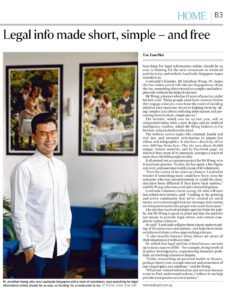
“Legal info made short, simple – and free”
– The Straits Times (2017)
The Senior Minister of State, Ministry of Law (Future Lawyering Conference 2017)
Asia Law Portal “30 People to Watch in the Business of Law” (2019)
870+ Google reviews (4.8 ★)
View Full Profile
A simple three-step process to get started quickly.
A quick call to understand your situation and see how we can help.
We review your situation, explain your options, and outline the best strategy.
Clear pricing agreed upfront. Your case handled directly by your lawyer.
How long does a divorce take, and when can I remarry?
An uncontested divorce typically takes about 3 to 5 months from filing to Final Judgment. A contested divorce usually takes 12 to 24 months, depending on how many issues are disputed and the court's schedule. The court first grants an Interim Judgment; the Final Judgment generally follows after the arrangements for children, maintenance and assets are resolved. You can only remarry once the Final Judgment is granted. Note that you usually cannot file for divorce within the first 3 years of marriage unless you can show exceptional hardship. The Family Justice Courts set out each stage in their official guide to divorce proceedings. Read our full guide to divorce in Singapore →
What's the difference between a contested and uncontested divorce?
In an uncontested divorce, both spouses agree on the reason for the divorce and on all arrangements: custody, care and control, access, maintenance and the division of matrimonial assets. It is faster and costs less, and the court can usually grant it on the documents filed, without either of you attending a hearing. In a contested divorce, one or more of these issues is disputed, and the Family Justice Courts decide them after mediation and, if needed, a hearing. Many cases that start contested settle along the way. Contested vs uncontested divorce explained →
How much does a divorce cost in Singapore?
The cost depends mainly on whether your divorce is uncontested or contested, and on whether there are disputes over children, maintenance or matrimonial assets. An uncontested divorce costs significantly less than a contested one. Court filing fees are payable on top of legal fees. We give you a fixed fee in writing after a free 10-minute call, so you know the full cost before any work begins. Ask for a fixed-fee quote →
How do the courts decide child custody, care and control?
The court's paramount consideration is the welfare of the child. Custody covers major long-term decisions such as education, religion and serious medical treatment, and is usually shared by both parents. Care and control decides which parent the child lives with day to day, and the other parent is normally given access. Shared care and control is possible where it serves the child's welfare. Custody, care and control explained →
How are matrimonial assets divided?
Singapore courts divide matrimonial assets, such as the HDB flat or private property, CPF savings, bank accounts and investments, on a just and equitable basis. They weigh each spouse's direct financial contributions together with indirect contributions, such as caring for the home and children. In longer marriages, the division tends to move closer to equal. Division of matrimonial assets explained →
How is maintenance calculated?
There is no fixed formula. The court looks at the needs of the wife (or an incapacitated husband) and the children, each party's income, earning capacity and financial resources, and the standard of living the family enjoyed during the marriage. Both parents have a duty to maintain their children. Maintenance can be paid monthly or, in some cases for a spouse, as a lump sum. How maintenance works in Singapore →
What is a consent order, and can it be changed later?
A consent order is a court order that records the terms you and your spouse have agreed, for example on the children, maintenance or the division of assets, so the court does not have to decide them after a contested hearing. It binds you both like any other court order. The Women's Charter allows the court to vary a consent order only in limited and special circumstances, so it is worth getting the terms right before you sign. When consent orders can be varied →
What is a Deed of Separation?
A Deed of Separation is a private written agreement for spouses who want to live apart but are not ready to divorce. It records your arrangements for the children, maintenance and property. It does not end the marriage, but if you divorce later, the court can take the agreement into account. We quote a fixed fee for preparing one after a free 10-minute call. Deed of Separation explained →
What is a Personal Protection Order (PPO), and how long does it last?
A Personal Protection Order (PPO) is a court order that restrains a family member from committing family violence against you or your children. You apply at the Family Justice Courts, and in urgent cases the court can grant an Expedited Order quickly. A PPO lasts for the period the court sets or, if none is set, indefinitely until the court varies or cancels it. A PPO is separate from divorce, but the two can run at the same time. Personal Protection Orders explained →
Can Muslim couples divorce in the Family Justice Courts?
It depends on how you were married, not simply on your religion. If you married under Muslim law, your divorce is handled by the Syariah Court under the Administration of Muslim Law Act. If you had a civil marriage under the Women's Charter, your divorce is handled by the Family Justice Courts, even if one or both of you are Muslim. Muslim and civil divorce explained →

November 25, 2026
How to enforce a maintenance order in Singapore under the new Maintenance Enforcement Process, the orders the court can make, and when to vary an order.

November 25, 2026
How Singapore courts decide custody, care and control, and access after divorce, and what you can do if the other parent breaks an access order.
November 25, 2026
Who can apply for a PPO in Singapore, the protective orders available since the 2025 changes, how to file, and what happens if the order is breached.
View All Articles →



